
Cheevajit Magazine, Issue No. 586, October 2023.

A Clear Vision for Life: The Inspiring Journey of Master Bobi and ISOPTIK
While spectacles are primarily tools for clearer vision, they can also enhance one's personality and professional image. However, their true value lies much deeper. A pair of glasses that restores sharp, natural vision at all distances instantly can significantly improve brain function, the body's central command system. When the brain, body, and mind are in harmony, one's work and overall quality of life improve drastically.
This philosophy is the driving force behind Mr. Somboon Numthipjuntacharern, Director of the ISOPTIK Ultra-Individualized Progressive Lens Center. Known globally among leading lens manufacturers and progressive lens experts as "Master Bobi," he is a pioneer in progressive lens innovation. Recognized by major German lens companies, Master Bobi has traveled the world, training countless eye care professionals in advanced 3D ultra-individualized progressive lens fitting systems.
In this special edition, Cheewajit is honored to have Master Bobi share his inspiration for creating 3D ultra-individualized intelligent progressive lenses, delve into the history of progressive lenses, and offer advice on choosing the right lenses through the lens of the ISOPTIK center.
Inspired by a Father's Legacy
Master Bobi recounts his inspiration: "I was born into a family that has been making high-end eyeglasses for generations, starting with my father, Sawang. He was the first in Thailand to pioneer 3D individualized eyeglasses 60 years ago. Back then, most optical shops only knew about nearsightedness, farsightedness, and presbyopia (farsightedness due to age). But my father already had the knowledge to measure astigmatism and latent squint. There were very few optometrists at that time, so finding someone who could measure these conditions was rare."
His father, a Thai of Hainanese descent born in Trang province, was originally a gold dental technician. He switched professions after realizing Trang lacked an optical shop, and people were using ready-made glasses without proper eye exams. He decided to purchase a Phoropter, a modern eye examination device, becoming one of the first in Thailand to own one. He spent a year in Bangkok learning how to use the equipment and cut lenses before returning to open "Sawang Optical" in Trang.
"My father was extremely meticulous about cutting lenses. He measured everything in detail, not just the degree of nearsightedness or farsightedness. He measured distance and near astigmatism, distance and near latent squint, the distance between the cornea and the lens, the position of the frame on the face, the pantoscopic tilt, the face form angle, the temple length, and adjusted the frame to fit each customer's nose bridge and face shape. All of these factors affect visual quality. He used the best quality lenses available at the time. People who got glasses from my father felt comfortable because they were 3D individualized glasses that corrected astigmatism and latent squint. If the glasses are not in the right position, vision can be distorted to the point of causing headaches. The frames my father sold back then were 18-karat gold frames from Germany, costing 3,000 baht each. At that time, gold was 300 baht per baht-weight. Customers loved them because they could be worn for decades without tarnishing. My father's shop, Sawang Optical, is still open today."

Saving Lives Through Vision
Having a family business as a foundation is one thing, but without passion and determination, carrying on the legacy successfully is another. "As far back as I can remember, I worked in Sawang Optical, doing everything from sweeping the floor, cleaning glass and spectacles, serving water to customers, to managing queues. What I saw was that customers respected my father very much. Everyone thanked him for making good glasses for them."
"There's one case I was very impressed with. A female customer came to see my father with severe headaches, nausea, and vomiting. At that time, she had been diagnosed with a mental illness and had to take sedatives, but her symptoms got worse. Later, she heard a radio advertisement saying that if she wore glasses from Sawang Optical, her headaches would be cured. Before making the glasses, my father asked about her symptoms. She had pain in her head, eye sockets, forehead, crown, down to her right and left occiput, shoulder pain, nausea, and vomiting. My father suspected astigmatism and latent squint. When he examined her thoroughly, he found nearsightedness, distance and near astigmatism, distance and near latent squint, and presbyopia. After my father made glasses for her, her pain completely disappeared. This made me realize that making glasses can save people's lives."
"When I was 7 years old, I was helping my father attend to a customer who was a governor moving from Trang to Chiang Mai. Traveling from Chiang Mai to Trang wasn't as easy back then. The governor told my father, 'The glasses you make are very comfortable. Traveling isn't a problem, but if you were to pass away, who would make such good glasses for me?' My father pointed at me and said, 'If I die, this son of mine will make the best glasses in the world for you. Don't worry.' Hearing that gave me goosebumps."
"That night, I dreamed of leaders – presidents, prime ministers, millionaires, and elites from all over the world – flying in to get glasses from me because I made the best glasses in the world. I woke up in the morning and told my dream to my parents and siblings. My mother laughed and said I was delusional. My eldest brother said I was crazy. But my father said simply, 'If you believe, you can achieve anything.' From that day on, at the age of 7, I was determined to become the person who makes the best glasses in the world."
"Since then, every breath I took was about making the best glasses in the world. When my father made glasses, I was always there, observing how he measured eyes, cut lenses, fitted frames, adjusted frames, delivered glasses to customers, and took care of them. I gathered all the details and practiced making glasses by learning from him. When salespeople from lens companies came to the shop, I liked to talk to them, always learning about products, news, and new technologies."
The History of Progressive Lenses

"Eyeglasses have been around for over 700 years, starting with single-vision lenses, meaning they are used for seeing at a single distance. For example, people over 50 would need at least three pairs of glasses: one for distance vision when walking, one for near vision when reading, and another for intermediate vision, about 80 centimeters, when working with a computer."
"Over 200 years ago, Benjamin Franklin, an American inventor, had the same problem. He had been farsighted for distance since he was a child. When he was over 40, he also started having presbyopia. He had to wear two pairs of farsighted glasses: one for distance and one for near. Being an inventor, when he was 50, his working distance was at 80 centimeters, so he needed another pair for intermediate vision, making it three pairs. He would keep one on his head, one hanging around his neck, and wear one on his eyes. He then invented bifocals by cutting two lenses and gluing them together in the same frame: the top part for distance and the bottom for near. This reduced his glasses from three pairs to two: a bifocal pair for distance and near, and a single-vision pair for intermediate distance. The problem with bifocals is that they are difficult to walk in and make judging distance hard, easily leading to accidents like tripping."
"The person who first invented progressive lenses 116 years ago was Owen Aves, a British optometrist. Since bifocals only provide clear vision at two distances, the image would jump back and forth, making walking quite difficult. He wanted a lens that could see clearly at all distances, so he thought of inventing progressive lenses, which are lenses that can see at all distances by gradually changing the lens power from the top to the bottom in up to 100 gradual steps. However, it was not practical because the peripheral distortion was very high, causing severe headaches when worn."
"Progressive lenses were further developed until the 1950s, when a single-design progressive lens that was practical started to appear. However, it still had weaknesses: high peripheral distortion. To look to the side, one had to slowly turn their entire head. Turning quickly would cause dizziness. Or when looking at documents, focusing was very slow. When looking at a computer screen or eating, one had to move their head up, down, left, and right to find the clear spot first. The success rate of actual progressive lens usage in that era was only 2% out of 100 pairs; only 2 pairs were wearable."
"Forty-three years later, in 1993, a leap forward occurred with semi-finished progressive lenses with 12 variable designs based on presbyopia power. This reduced peripheral distortion and allowed for faster focusing. They were sold at 5,000 baht per pair, which were the most expensive progressive lenses at that time. I tested this model of progressive lenses with customers and found that the quality was better than all other progressive lens models in that era. I therefore created a trial set for this model of progressive lenses on a mock-up frame that could adjust the center of the progressive lens position in 3D, so that each user could try wearing and using them according to their actual visual behavior before buying."
The World's First 3D Progressive Lens Trial Set
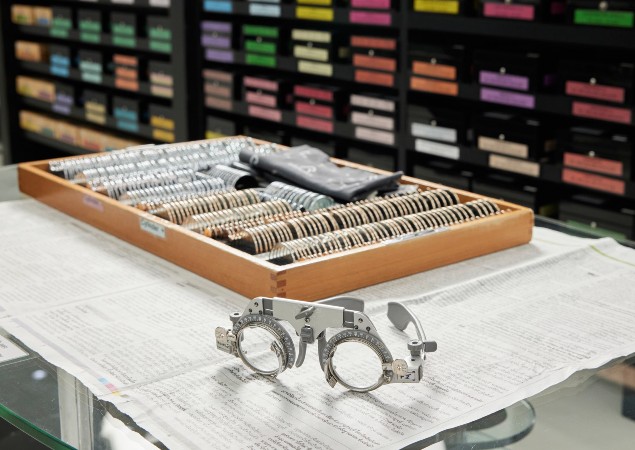
Having been involved in the optical business since childhood, Master Bobi possesses a deep understanding of each customer's individual visual needs. This led to the creation of the 3D progressive lens trial set, designed to address the challenges and fulfill the requirements of those seeking progressive glasses. "Thirty years ago, I was the first to create this 3D progressive lens trial set. The concept was that communicating to customers about progressive lenses at different price points by just verbally explaining how good they are didn't allow them to visualize or understand. At that time, progressive lenses ranged from 1,000 baht to 5,000 baht per pair. I created progressive lens trial sets at every price level so customers could try them out for themselves in real-world scenarios. This allowed us to sell a lot of the highest-quality progressive lenses of that era, at 5,000 baht per pair, because when customers tried them, they clearly saw the difference. A 1,000 baht pair made them feel dizzy and made walking difficult. A 2,000 baht pair was easier to walk in but still caused dizziness. A 3,000 baht pair was more comfortable but still not natural. But when they put on the top-tier 5,000 baht progressive lenses, the image was natural and much more comfortable, so customers could decide immediately."
"Besides that, I used this progressive lens trial set to adjust the structure of the progressive glasses to suit each customer, determining how high or low to set the lens center and whether the fitting should be centered on the pupil, or higher or lower than the pupil center, depending on their specific visual behavior."
"My trial set can hold 4 lenses on each side: the first lens corrects nearsightedness or farsightedness, the second corrects astigmatism, the third corrects latent squint, and the fourth is a normal progressive lens. Currently, ISOPTIK has over 100 intelligent progressive structures to try. Importantly, the mock-up frame set can adjust the 3D center to fit each person's face shape independently."

Pioneering the High-End Progressive Lens Market in Thailand
In 2000, Master Bobi pushed for high-end progressive lenses with 72 structures based on distance vision and the latest presbyopia power to be sold in Thailand, with exclusive distribution rights. Priced at 10,000 baht per pair, they achieved top-tier sales globally. These progressive lenses were easier to adapt to and more comfortable than before.
Innovation in High-End Progressive Lenses
In 2002, Master Bobi introduced personalized free-form progressive lenses from Germany to Thailand. These lenses were manufactured according to nearsightedness, farsightedness, astigmatism, distance latent squint, presbyopia, the position of the pupil center of each eye on each frame in 3D, the difference in the vertex distance on the trial lens set versus the actual glasses, and the near-convergence of each eye. This resulted in progressive glasses that offered the highest level of visual quality of that era, being the first progressive lenses to provide clear vision at all distances instantaneously and naturally. Priced at 40,000 baht per pair, these progressive lenses required the position of the frame on the face to be measured in 3D using special tools that Master Bobi was already skilled with, allowing him to sell a large volume of these lenses. However, this model of progressive lenses failed in the global market due to errors in measuring the frame position on the face and the near-convergence distance of each eye, reducing lens efficiency by 10 times. Master Bobi was invited to teach the correct measurement methods in many countries around the world, eventually increasing sales of this progressive lens model by 100 times globally. The title "Master Bobi" came from teaching, as his students called him "Grandmaster Bobi."
In 2007, Master Bobi pushed for a German manufacturer to produce a new generation of progressive lenses, which has been a major leap forward in progressive lens development to the highest level to this day. By changing from the previous system of having fixed power change rates for 3 distances (near, intermediate, far) to being able to define the precision at 0.1 millimeters, the lens has 210 levels of precision and produces prescriptions that are 25 times more precise than before, from steps of 0.25 diopters to 0.01 diopters. This allows for a more refined lens structure, resulting in progressive glasses that are as comfortable as if they were a natural part of the body.
In 2010, Master Bobi pushed for the production of another new generation of progressive lenses that can independently define the width of the far, intermediate, and near zones. This was another leap forward for the global progressive lens industry, as it allowed for specifying the percentage of focus on distance, intermediate, and near vision according to each user's visual behavior, thus better meeting customers' needs. Comparing them, with normal progressive glasses, one has to tilt their head up to see a computer clearly. But with this new model, one can look straight ahead.
"Many customers fly in from abroad to buy from us. While it's true that German progressive lenses are sold worldwide, not every shop cuts them the same because the detailed design process is different. I am a designer of ultra-individualized intelligent progressive lenses, designing them specifically according to each user's actual visual behavior and the true position of their eyes on each frame."

Currently, Master Bobi continues to push progressive lens manufacturers to relentlessly develop progressive lenses. The latest intelligent progressive lenses are cut according to the structure of each eyeball, resulting in a wider field of view, greater comfort, a more natural feel, and faster focusing.
"By helping people see better, we are improving their quality of life. They can work faster, tire less, have increased energy, a significant boost in brainpower, enjoy life more, and have more fun. Most importantly, they have better health. Good vision leads to good health. If vision is poor, health will also be poor. Our bodies perceive with our eyes, but we see with our brains. If the eyes don't see a clear image, the brain commands the eyes to strain. The more you strain, the more energy the brain has to use for this, making you feel drowsy, fatigued, and unable to think clearly. A task that took one hour in your youth might take three hours when you're 50. We slow down continuously as our vision declines. We make glasses so customers can be young again, to see clearly at all distances as naturally and comfortably as possible. If vision is youthful, the brain will return to being youthful, energy will return, and life will be better."
"ISOPTIK's work is to make everyone see images clearly at all distances in a split second, as naturally and comfortably as possible, just like returning to being young again."
Ophthalmologists: Crucial for Eye Health Analysis and Quality Lenses

ISOPTIK is a high-end optical center that also offers eye examinations by ophthalmologists. This is because if the eyes have abnormalities or hidden diseases, it can cause inaccuracies in the eye exam for glasses. Dr. Nattida Nimvorapun, an ophthalmologist at the ISOPTIK Ultra-Individualized Progressive Lens Center, explains: "For those who come to get glasses at the shop, if they want to see an ophthalmologist for an eye exam, they can. And in cases where customers have problems with their eye measurement – for instance, no matter how it's measured, they still can't see clearly, or at first they say it's clear, but after a while when measured again, it's not clear anymore – optometrists will refer them to an ophthalmologist to check what the cause is, such as dry eyes, cataracts, glaucoma, or macular degeneration. If they have these diseases, we will recommend treating them first before returning for a new eye exam and glasses."
"The most common diseases found are dry eyes and cataracts. If dry eyes are severe, it can cause corneal ulcers, feeling like looking through frosted glass all the time. Blinking makes the image clear for a moment, then it returns to being blurry. In this case, we recommend using artificial tears for 2 weeks and then coming back for a new eye exam."
"For cataracts, no matter how the prescription is measured, it won't be clear. If the symptoms are not severe, wearing glasses can help see clearer. This depends on the patient's satisfaction as well. If they get glasses and, even though they can't see as normally, the patient is satisfied because they don't want surgery, that's fine too. But ISOPTIK prefers customers to have cataract surgery first and then come back for glasses to get the most accurate prescription."
"Unless the cataract causes a significant change in prescription, for example, someone who was -1.00 becomes -4.00. In such a case, we would recommend surgery before getting glasses."
"There have been customers who, seeing that there is an ophthalmologist, ask for an eye health check as well. It turned out they were found to be at risk of glaucoma. This disease is silent; if you don't get checked, you won't know you have it because there are no symptoms. We would recommend them to go for further examination at a hospital."
"Usually, when patients have dizziness, they are often referred to an ophthalmologist first to check if it is due to vision. If the prescription is normal or corrected with glasses and the dizziness doesn't improve, then they should investigate other causes."
When are Glasses Necessary?
"In cases where glasses are seriously needed, it's mostly children. If a child cannot see clearly because their vision has not fully developed, and if they don't wear glasses to correct it, lazy eye can occur. If not corrected quickly before age 9, it will be blurry like that for life because the brain has already memorized that this is the clearest image. But if we give the child glasses to see clearly and stimulate the good eye before age 9, they can return to seeing clearly as normal."
"Normally, before age 20, people's nearsightedness will increase anyway. After that, the prescription will stabilize. For nearsighted people, not wearing glasses does not make nearsightedness worse than it is."
"As for what level of prescription requires glasses, if you feel you can't see clearly, no matter how small the value, you should get glasses so you don't have to strain. Straining for a long time will cause headaches and dizziness."
"Wearing glasses makes our eyes more comfortable, so we don't have to strain much, helping to prevent eye fatigue, which leads to dry eyes because when we strain, we blink less, and our eyes get dry. But if we don't wear glasses and have no problems seeing or don't have to strain, it's not necessary to wear glasses all the time."
"Before age 40, no matter how high or low the prescription is, there's usually not much of a problem because it's the vision we were born with. But after age 40, problems with presbyopia (age-related farsightedness) begin, which increases with age. This requires wearing one pair of glasses for distance and one for near vision. Wearing progressive glasses helps make daily life easier because you don't have to use multiple pairs of glasses. This depends on the visual behavior of the customer and what is convenient for them. If they only drive and don't read books or work with documents much, they can get glasses for distance vision only. But if they want glasses that can see near, far, and intermediate distances without a line on the lenses, then progressive glasses are recommended."
The Importance of Progressive Lens Design
"If the lens design is poor or lacks precision, it can cause headaches or distorted images, for example, a square might look like a trapezoid. Or glancing to the side might cause image distortion, and glancing quickly might cause dizziness. In this case, one needs to practice turning their whole head when they want to look to the side."
"Besides that, if the lens design doesn't suit the behavior, for instance, if the customer's behavior is mostly distance viewing, but the lens is designed for near viewing, when used for distance viewing, the image will be distorted and can cause dizziness."
"Most progressive lens problems are related to fitting. Normally, the frame is designed to be exactly in the center. But if the glasses are worn lower than the center, it can cause headaches. Or sometimes, if you walk into something and the glasses get bent, the image can be distorted. For progressive glasses, the position of the glasses significantly affects vision."
"Getting glasses is like going to a tailor shop. If this shop's fitting is comfortable, not every part has to be perfect, you can buy and wear it right away. Some shops cut beautiful suits, but if we wear them and are not comfortable, it shows that the clothes from that shop don't suit us."
"Optometrists": The Primary Eye Care Problem Solvers

An "Optometrist" is an expert in performing eye exams to determine the appropriate lens power, analyzing daily visual behavior, and screening for primary eye abnormalities. If any abnormalities are found, they will recommend seeing an ophthalmologist.
Ms. Kusuma Riankum, an optometrist at the ISOPTIK Ultra-Individualized Progressive Lens Center, talks about the eye examination steps here: "Master Bobi has established a detailed system for vision analysis and measurement, which is a unique specialty. Optometrists apply their knowledge with the most modern technology. Our eye exam must make the service user feel as relaxed as possible. If they feel stressed or in a bad mood, we might have to pause the measurement for a while and then return to it so that the prescription is as accurate as possible. We observe customers very closely, for instance, if they have been running a lot, we must let them sit and rest first. If customers are carrying things, there will be a plan to take care of their bags so they don't have to worry because everything affects the vision measurement."
"Before examining the eyes, we have to take a detailed customer history, including visual behavior, occupation, age, hours of eye use, devices used in daily life, viewing levels, viewing distances, any underlying diseases, and medications being taken. For example, taking allergy medication can cause dry eyes, which will make the prescription inaccurate. If abnormalities suspected to be diseases are found, we will refer them to an ophthalmologist."
"Some customers have multiple vision problems in one person, such as nearsightedness, farsightedness, astigmatism, latent squint, and presbyopia. This makes them need multiple pairs of glasses for appropriate use. Our progressive lenses can solve all their problems with a single pair of glasses, making their usage more convenient."
"We don't just make the best glasses suitable for each individual, but we also provide detailed consultation and advice on how to use the glasses correctly so that customers can use their glasses most efficiently, helping their lives to be of higher quality than before."
"We will ask customers to try following the advice after receiving the glasses on how to look, and let them test viewing at near and far distances, going up and down stairs, letting customers practice using the lenses until they can use them for real. We will let customers try until they are confident and will monitor the usage results all the time. If any problems occur, they can come back to the shop for corrections until they can use the glasses in their daily lives efficiently. So far, customers have been very satisfied with the results."

The Heart of Ultra-Individualized Intelligent Progressive Lenses
When asked what the heart of ultra-individualized intelligent progressive lenses is, Master Bobi explained: "Designing progressive lenses to fit the actual, specific usage behavior is called ultra-individualized intelligent progressive. ISOPTIK's visual system analysis is a vision analysis developed specifically for making progressive glasses, which has an opposite measurement principle. Normally, for farsighted people, traditional measurements will use the highest farsightedness value that provides clear vision as the value for making glasses. But at ISOPTIK, we use the lowest farsightedness value that provides the clearest vision for making progressive glasses. If it's nearsightedness, generally the lowest nearsightedness that gives the best vision will be used. At ISOPTIK, we give the highest nearsightedness value that is clearly visible, which allows for progressive lenses that are clear at all distances without having to lower one's head."
"ISOPTIK is different in that we analyze the visual system, including distance nearsightedness, distance farsightedness, near farsightedness, distance latent squint, near latent squint, distance astigmatism, and near astigmatism, with detailed measurements. Besides that, we also scan the entire eyeball to use the eye scan data to build ultra-individualized lenses."
The Process of Getting Glasses at ISOPTIK

Make an appointment in advance and prepare by getting enough rest so your eyes are relaxed and haven't been straining all day. Bring all your current glasses on the appointment day.
When you arrive for your appointment, the first step is for the team to take a detailed history of your visual behavior: what your occupation is, what your hobbies are, the nature of your computer use, computer position, screen height distance, screen size in inches, how many hours you work per day, whether you use a desktop or laptop, how much you read, document sizes, whether you read newspapers or pocketbooks, what sports you play, especially golf, tennis, badminton, including driving vehicles – driving a sedan, SUV, or sports car is not the same. Especially if it's a motorcycle, it's even more different.
Measure visual acuity with the naked eye. Measure visual acuity with existing glasses by measuring distance, intermediate, and near distances. After that, undergo an examination with an optometrist, checking again with a 3D digital machine to analyze the visual system specifically for making progressive glasses.
Then, facial measurements and nasal bridge length are taken to design an individualized frame that fits each person's face shape. Frames are available to choose from in terms of shape, temple size, and frame size. Names can be engraved up to 27 characters. There are a total of 47 colors, produced individually, piece by piece, starting at 18,800 baht. Intelligent progressive lenses start at 18,800 baht per pair, rimmed.
For those who want to know how ISOPTIK's ultra-individualized 3D intelligent progressive lenses can significantly boost brainpower, you can make an appointment to test the lenses with your own brain at:
ISOPTIK : The Hi-End Eyeglasses Centre
Grandmaster BOBI Hotline : 081-538-4200
Tel. : โทร : 097-454-9944
LINE ID : @isoptik
Open every Wednesday to Sunday
10:00 AM to 7:00 PM